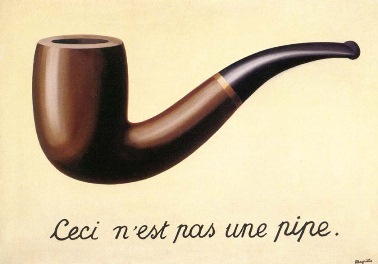
A 1929 painting by Belgian Surrealist painter René Magritte. The inscription says "this is not a pipe".
Separation between linguistic signs and plastic elements; equivalence of resemblance and affirmation. These two principles constituted the tension in classical painting, because the second reintroduced discourse (affirmation exists only where there is speech) into an art from which the linguistic element was rigorously excluded. Hence the fact that classical painting spoke – and spoke constantly – while constituting itself entirely outside language; hence the fact that it rested silently in a discursive space; hence the fact that it provided, beneath itself, a kind of common ground where it could restore the bonds of signs and the image. Magritte knits verbal signs and plastic elements together, but without referring them to a prior isotopism. He skirts the base of affirmative discourse on which resemblance calmly reposes, and he brings pure similitudes and nonaffirmative verbal statements into play within the instability of a disoriented volume and an unmapped space. A process whose formulation is in some sense given by Ceci n’est pas une pipe. (Faucault 1973 rp 1983:53)
Foucault, Michel (1973 rp 1983) This is Not a Pipe: University of California Press
In the above quote Foucault discuss how Maggritte uses text to affirm the meaning of the image, whereas most artists of the time would use image only to get across a point. Text, speech or other methods can be used then to narrate and explain the meaning of an image.
But who would seriously contend that the collection of intersecting lines above the text is a pipe? Must we say: My God, how simpleminded! The statement is perfectly true, since it is quite apparent that the drawing representing the pipe is not the pipe itself. And yet there is a convention of language: What is this drawing? Why, it is a calf, a square, a flower. An old custom not without basis, because the entire function of so scholarly, so academic a drawing is to elicit recognition, to allow the object it represents to appear without hesitation or equivocation. (Foucault 1983:19-20)
Foucault, Michel (1983) This is Not a Pipe: University of California Press
Foucault, Michel (1983) This is Not a Pipe: University of California Press

No comments:
Post a Comment