If we were able to take as the finest allegory of simulation the Borges tale where the cartographers of the Empire draw up a map so detailed that it ends up exactly covering the territory (but where, with the decline of the Empire this map becomes frayed and finally ruined, a few shreds still discernible in the deserts - the metaphysical beauty of this ruined abstraction, bearing witness to an imperial pride and rotting like a carcass, returning to the substance of the soil, rather as an aging double ends up being confused with the real thing), this fable would then have come full circle for us, and now has nothing but the discrete charm of second-order simulacra.
Abstraction today is no longer that of the map, the double, the mirror or the concept. Simulation is no longer that of a territory, a referential being or a substance. It is the generation by models of a real without origin or reality: a hyperreal. The territory no longer precedes the map, nor survives it. Henceforth, it is the map that precedes the territory - precession of simulacra - it is the map that engenders the territory and if we were to revive the fable today, it would be the territory whose shreds are slowly rotting across the map. It is the real, and not the map, whose vestiges subsist here and there, in the deserts which are no longer those of the Empire, but our own. The desert of the real itself. (Baudrillard 1988:169)
Baudrillard, Jean (1988 rp 1998) Selected Writings: Stanford University Press
Monday, 16 April 2007

Friday, 13 April 2007
Plato's Cave (quote)
Now consider what would happen if their release from the chains and the healing of their unwisdom should com about in this way. Suppose one of them is set free and forced suddenly to stand up, turn his head, and walk with his eyes lifted to the light; all these movements would be painful, and he would be too dazzled to make out the objects whose shadows he had been used to see. What do you think he would say, if someone told him that what he had formerly seen was meaningless illusion, but now, being somewhat nearer to reality and turned towards more real objects, he was getting a truer view? Suppose further that he were shown the various objects being carried by and were made to say, in reply to questions, what each of them was. Would he not be perplexed and believe the objects now shown him to be not so real as what he formerly saw?
Yes, not nearly so real.
And if he were forced to look at the fire-light itself, would not his eyes ache, so that he would try to escape and turn back to the things which he could see distinctly, convinced that they really were clearer than these other objects now being shown to him? (Cornford 1941 rp 1966:224)
Cornford, Francis Macdonald (1941 rp 1966) The Republic of Plato: Oxford Univrsity Press
Yes, not nearly so real.
And if he were forced to look at the fire-light itself, would not his eyes ache, so that he would try to escape and turn back to the things which he could see distinctly, convinced that they really were clearer than these other objects now being shown to him? (Cornford 1941 rp 1966:224)
Cornford, Francis Macdonald (1941 rp 1966) The Republic of Plato: Oxford Univrsity Press
Thursday, 12 April 2007
Susan Sontag Quotes
http://en.wikiquote.org/wiki/Susan_Sontag
"The truth is always something that is told, not something that is known. If there were no speaking or writing, there would be no truth about anything. There would only be what is."
The Benefactor (Farrar, Straus and Giroux, 1963, ISBN 0-312-42012-9), ch. 1 (p. 1)
Quotes from On Photography - ISBN 0385267061
"So successful has been the camera's role in beautifying the world that photographs, rather than the world, have become the standard of the beautiful."
"The Heroism of Vision" (p. 85)
"The destiny of photography has taken it far beyond the role to which it was originally thought to be limited: to give more accurate reports on reality (including works of art). Photography is the reality; the real object is often experienced as a letdown."
"Photographic Evangels" (p. 147)
"Reality has come to seem more and more like what we are shown by cameras. It is common now for people to insist upon their experience of a violent event in which they were caught up — a plane crash, a shoot-out, a terrorist bombing — that "it seemed like a movie." This is said, other descriptions seeming insufficient, in order to explain how real it was. While many people in non-industrialized countries still feel apprehensive when being photographed, divining it to be some kind of trespass, an act of disrespect, a sublimated looting of the personality or the culture, people in industrialized countries seek to have their photographs taken — feel that they are images, and are made real by photographs."
"The Image-World" (p. 161)
"The truth is always something that is told, not something that is known. If there were no speaking or writing, there would be no truth about anything. There would only be what is."
The Benefactor (Farrar, Straus and Giroux, 1963, ISBN 0-312-42012-9), ch. 1 (p. 1)
Quotes from On Photography - ISBN 0385267061
"So successful has been the camera's role in beautifying the world that photographs, rather than the world, have become the standard of the beautiful."
"The Heroism of Vision" (p. 85)
"The destiny of photography has taken it far beyond the role to which it was originally thought to be limited: to give more accurate reports on reality (including works of art). Photography is the reality; the real object is often experienced as a letdown."
"Photographic Evangels" (p. 147)
"Reality has come to seem more and more like what we are shown by cameras. It is common now for people to insist upon their experience of a violent event in which they were caught up — a plane crash, a shoot-out, a terrorist bombing — that "it seemed like a movie." This is said, other descriptions seeming insufficient, in order to explain how real it was. While many people in non-industrialized countries still feel apprehensive when being photographed, divining it to be some kind of trespass, an act of disrespect, a sublimated looting of the personality or the culture, people in industrialized countries seek to have their photographs taken — feel that they are images, and are made real by photographs."
"The Image-World" (p. 161)
Parables/Analogy
Symbols, analogies etc can be used to explain abstract concepts, therfore making them more 'real' to the person receiving them.
Symbolism and parables are used heavily in the Bible:-
"Therefore speak I to them in parables: because they seeing see not; and hearing they hear not, neither do they understand."
Matt13:13 - http://scriptures.lds.org/en/matt/13 (need publisher info + page no.)
As in Plato's Cave, the symbol or representation of a thing can be easier to digest than the thing itself
Symbolism and parables are used heavily in the Bible:-
"Therefore speak I to them in parables: because they seeing see not; and hearing they hear not, neither do they understand."
Matt13:13 - http://scriptures.lds.org/en/matt/13 (need publisher info + page no.)
As in Plato's Cave, the symbol or representation of a thing can be easier to digest than the thing itself
Wednesday, 4 April 2007
Photographs

The famous photo of Phan Thi Kim Phúc taken on 8th June 1972 near Trang Bang, Vietnam taken by Huynh Cong Ut (also known as Nick Ut).
Photo's similar to this one along with video footage made the war seem more 'real' to the American public, putting pressure on the government to pull out.
The Treachery of Images
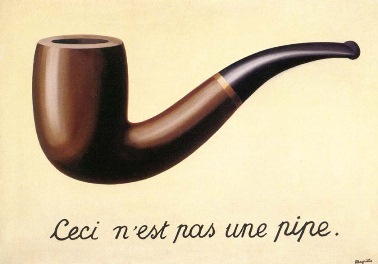
A 1929 painting by Belgian Surrealist painter René Magritte. The inscription says "this is not a pipe".
Separation between linguistic signs and plastic elements; equivalence of resemblance and affirmation. These two principles constituted the tension in classical painting, because the second reintroduced discourse (affirmation exists only where there is speech) into an art from which the linguistic element was rigorously excluded. Hence the fact that classical painting spoke – and spoke constantly – while constituting itself entirely outside language; hence the fact that it rested silently in a discursive space; hence the fact that it provided, beneath itself, a kind of common ground where it could restore the bonds of signs and the image. Magritte knits verbal signs and plastic elements together, but without referring them to a prior isotopism. He skirts the base of affirmative discourse on which resemblance calmly reposes, and he brings pure similitudes and nonaffirmative verbal statements into play within the instability of a disoriented volume and an unmapped space. A process whose formulation is in some sense given by Ceci n’est pas une pipe. (Faucault 1973 rp 1983:53)
Foucault, Michel (1973 rp 1983) This is Not a Pipe: University of California Press
In the above quote Foucault discuss how Maggritte uses text to affirm the meaning of the image, whereas most artists of the time would use image only to get across a point. Text, speech or other methods can be used then to narrate and explain the meaning of an image.
But who would seriously contend that the collection of intersecting lines above the text is a pipe? Must we say: My God, how simpleminded! The statement is perfectly true, since it is quite apparent that the drawing representing the pipe is not the pipe itself. And yet there is a convention of language: What is this drawing? Why, it is a calf, a square, a flower. An old custom not without basis, because the entire function of so scholarly, so academic a drawing is to elicit recognition, to allow the object it represents to appear without hesitation or equivocation. (Foucault 1983:19-20)
Foucault, Michel (1983) This is Not a Pipe: University of California Press
Foucault, Michel (1983) This is Not a Pipe: University of California Press
Dictionary Definition of Real
real1
/reel/
• adjective 1 actually existing or occurring in fact; not imagined or supposed. 2 significant; serious. 3 not artificial; genuine. 4 rightly so called; proper: a real man. 5 adjusted for changes in the value of money; assessed by purchasing power: real incomes had fallen by 30 per cent. 6 Mathematics (of a number or quantity) having no imaginary part.
http://www.askoxford.com/concise_oed/orexxal_1?view=uk
reality
• noun (pl. realities) 1 the state of things as they actually exist, as opposed to an idealistic or notional idea of them. 2 a thing that is actually experienced or seen. 3 the quality of being lifelike. 4 the state or quality of having existence or substance.
http://www.askoxford.com/concise_oed/orexxality?view=uk
simulacrum
/simyoolaykrm/
• noun (pl. simulacra/ simyoolaykr/ or simulacrums) 1 an image or representation of someone or something. 2 an unsatisfactory imitation or substitute.
— ORIGIN Latin, from simulare ‘copy, represent’.
http://www.askoxford.com/concise_oed/simulacrum?view=uk
realism
• noun 1 the practice of accepting a situation as it is and dealing with it accordingly. 2 (in art or literature) the representation of things in a way that is accurate and true to life. 3 Philosophy the doctrine that universals or abstract concepts have an objective or absolute existence. Often contrasted with NOMINALISM.
— DERIVATIVES realist noun.
http://www.askoxford.com/concise_oed/orexxalism?view=uk
nominalism
• noun Philosophy the doctrine that universals or general ideas are mere names without any corresponding reality. Often contrasted with REALISM.
— DERIVATIVES nominalist noun.
http://www.askoxford.com/concise_oed/nominalism?view=uk
/reel/
• adjective 1 actually existing or occurring in fact; not imagined or supposed. 2 significant; serious. 3 not artificial; genuine. 4 rightly so called; proper: a real man. 5 adjusted for changes in the value of money; assessed by purchasing power: real incomes had fallen by 30 per cent. 6 Mathematics (of a number or quantity) having no imaginary part.
http://www.askoxford.com/concise_oed/orexxal_1?view=uk
reality
• noun (pl. realities) 1 the state of things as they actually exist, as opposed to an idealistic or notional idea of them. 2 a thing that is actually experienced or seen. 3 the quality of being lifelike. 4 the state or quality of having existence or substance.
http://www.askoxford.com/concise_oed/orexxality?view=uk
simulacrum
/simyoolaykrm/
• noun (pl. simulacra/ simyoolaykr/ or simulacrums) 1 an image or representation of someone or something. 2 an unsatisfactory imitation or substitute.
— ORIGIN Latin, from simulare ‘copy, represent’.
http://www.askoxford.com/concise_oed/simulacrum?view=uk
realism
• noun 1 the practice of accepting a situation as it is and dealing with it accordingly. 2 (in art or literature) the representation of things in a way that is accurate and true to life. 3 Philosophy the doctrine that universals or abstract concepts have an objective or absolute existence. Often contrasted with NOMINALISM.
— DERIVATIVES realist noun.
http://www.askoxford.com/concise_oed/orexxalism?view=uk
nominalism
• noun Philosophy the doctrine that universals or general ideas are mere names without any corresponding reality. Often contrasted with REALISM.
— DERIVATIVES nominalist noun.
http://www.askoxford.com/concise_oed/nominalism?view=uk
Subscribe to:
Comments (Atom)